

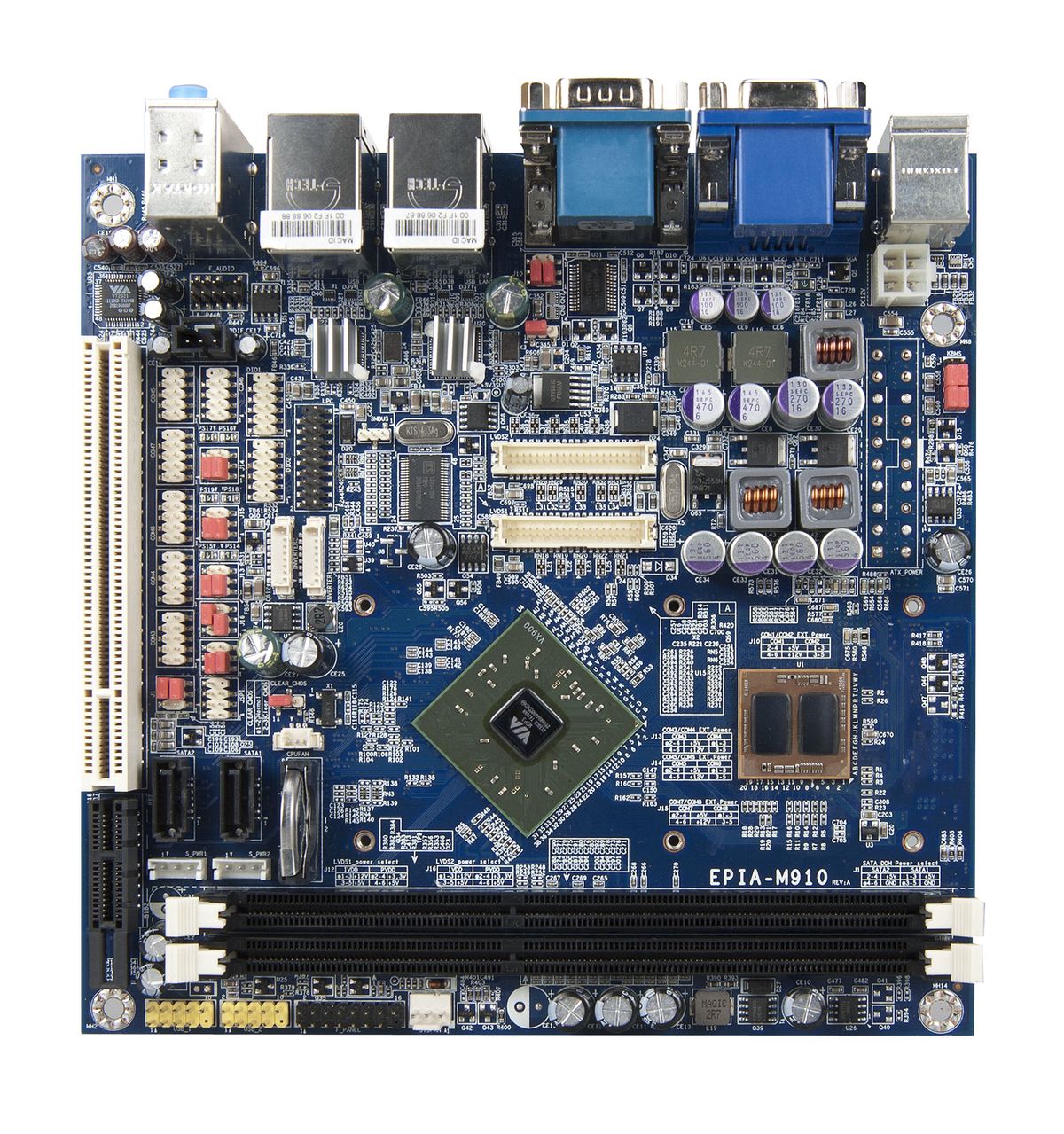
Form factor is the call that matters most on this build, and the popular answer gets it wrong. Every “quiet home-lab PC” guide points at mini-ITX: small, tucked in a corner, low power draw.
I already own an RTX 3060 and want a box around it that stays quiet, stays cool, and stays upgradable, meaning I can swap the CPU, RAM, storage, and eventually the GPU without replacing the motherboard underneath them. Mini-ITX fails on all three at once. Seeing why took real bench data and practitioner threads, not case marketing copy.
Mini-ITX trades away the two things this build needs#
Mini-ITX cases force two acoustic penalties that stay hidden until you look at the actual hardware inside them:
- Fan size. A small case only fits small, high-RPM fans, and small fans have to spin faster than large fans to move the same volume of air. Faster fans are louder fans.
- PSU size. ITX all but requires an SFX power supply instead of a full ATX unit, and SFX units run louder at idle because their tiny fans work harder inside a smaller housing.
Practitioner testing backs this up: builders chasing a genuinely silent PC report mATX and ATX cases as consistently quieter than ITX equivalents at equivalent airflow.
Mini-ITX also caps upgrade room in ways a spec sheet doesn’t show until you’re staring at four empty screw holes wondering where the second M.2 slot went. Most ITX boards ship two RAM slots, one M.2. That’s fine on day one. It’s a wall on day four hundred, when I want:
- A second GPU for a small inference cluster
- More NVMe for a growing model cache
- More RAM, without pulling both sticks to replace them
A build I’m calling upgradable at every part can’t start on a board that’s already out of holes.
mATX gets the noise win ITX promises but can’t deliver#
mATX solves the acoustic problem ITX claims to own, without the expansion penalty. A mATX case is roomy enough for a full ATX power supply and full-size 120mm or 140mm fans. Larger fans move the same air at lower RPM. That’s the actual mechanism behind a quiet build; the case size badge on the box has nothing to do with it.
mATX boards typically carry four RAM slots and two or three M.2 slots, plus a full-length PCIe slot for the GPU and often room for a second card down the road. I stop fighting the case for room to grow.
The tradeoff I’m accepting here is real. A mATX build sits noticeably larger on a desk or shelf than a genuinely compact ITX box. The Fractal Design Ridge measures around 32dB idle by itself, real engineering in a real quiet ITX case, and mATX doesn’t beat that on size.
But it wins on the constraint I actually have: upgrade room and noise together. If quiet in the smallest possible box is the only requirement, ITX with a case like the Ridge is still the right call. That isn’t my constraint set.
Socket choice decides how long the board lasts#
AM5 is the safer bet for a board I don’t want to replace in two years. AMD extended AM5 platform support through 2029, up from an earlier 2027 commitment, with Zen 6 and likely Zen 7 landing on the same socket.
Intel’s next socket, LGA1954, has only a VP’s public statement pointing toward similar multi-generation support, not a locked commitment the way AMD’s is. A CPU swap two or three years out should mean unscrewing four cooler mounts. It shouldn’t mean a new motherboard, new RAM, and an OS reinstall.
Chipset tier drives idle power more than the CPU spec sheet#
Chipset tier changes idle power draw on AM5 boards more than most builders expect. Measured bench data on a single-chip B650E board showed roughly 71W idle, tying the dual-chip X670E flagship board tested alongside it. The second chip on X670 and X670E boards buys nothing here. It just adds another die pulling power around the clock.
I’m buying a single-chip B650 or B650E board and skipping X670E outright. This machine runs continuously as an inference host, and idle draw compounds over a year in a way a gaming rig’s idle time never does. That’s the same idle-power math that decided my last box purchase.
The CPU’s job is sitting at 20W, not winning benchmarks#
The GPU carries the AI workload here, so the CPU’s real job is staying quiet at idle. A Ryzen 5 7600, non-X and without 3D V-Cache, measured around 20W idle in independent testing, a figure that held across two separate sources.
Picking the 3D-cache or X variant would buy gaming frame rates this box has no use for. The actual work happens on the GPU sitting next to it.
The power supply only needs to cover the real load#
An oversized power supply runs less efficiently on this build than a right-sized one. The RTX 3060 carries a 170W power spec set by Nvidia, and a Ryzen 5 7600 idles around 20W and stays well under 100W under load.
Measured efficiency curves tell the story:
- 600-650W ATX units peak near 91% efficiency at 50% load, and dip at both the 10% and 100% ends.
- A Corsair RM650e held 90.9% efficiency at 50% load, with average noise measured at only 12.6 dBA.
550 to 650W, full-size ATX, is the right target.
The board and case pick still isn’t verified#
One piece of this build isn’t locked yet. I haven’t picked a specific mATX board or case, and I don’t want to dress up a guess as a confirmed pick the way the rest of this list is confirmed. Candidates worth pricing out, none backed by the same measured bench data as the CPU, chipset tier, and PSU sizing:
- Board: ASRock B650M Pro RS or MSI B650M Mortar
- Case: Fractal Design Pop Air or Meshify 2 Compact
Reddit’s homelab and SFF communities would probably settle this faster than another round of vendor listicles, but that search hit a wall this round.
The build that comes out of all this:
- Platform: AM5, single-chip B650 or B650E board
- Case: mATX
- CPU: non-X Ryzen 5 7600
- GPU: the RTX 3060 I already own
- PSU: 550-650W full-size ATX, sized to the real load instead of an imagined one
None of the individual parts are exotic or expensive. The only decision that took real digging was form factor. The small-box answer everyone defaults to worked against what I actually needed: room to add parts later, without losing the quiet, and without running out of holes to screw them into.